The WaTr ontology supports modeling the processes involved in a water treatment system (e.g. "UV disinfection), the composition of the system and its components (e.g. “this reactor contains a mixer”), and the topology of the system (e.g. “this pump is connected to this reactor”).
To explain these concepts, we will use the following model of a ultraviolet disinfection system:
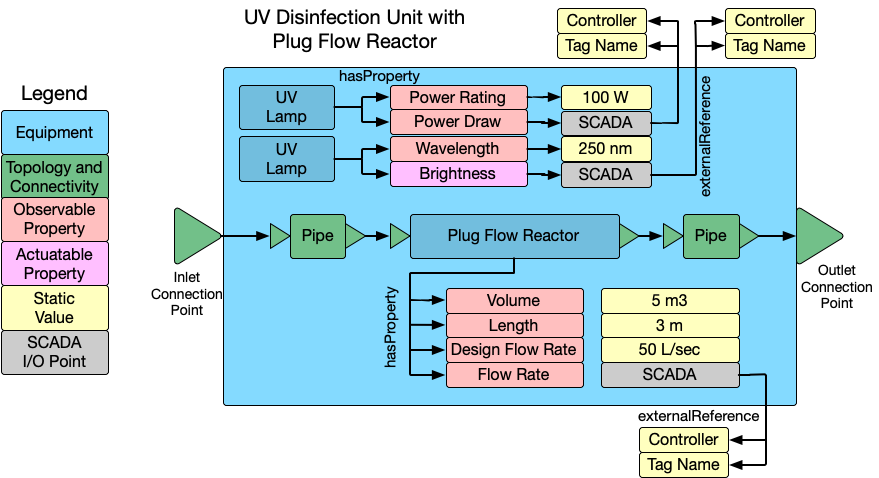
All of the polygons in this image represent a WaTr entity (a node in the graph) and the edges represent the relationships between them (the edges in the graph).
Composition
WaTr uses the concept of composition to represent how entities are made up of other entities. For example, our UV disinfection system is made up of 2 UV lamps and a plug flow reactor.
We model this using the s223:contains relationship between the lamps and the unit process equipment, and the reactor and the unit process equipment.
@prefix watr: <urn:nawi-water-ontology#> .
@prefix owl: <http://www.w3.org/2002/07/owl#> .
@prefix qudt: <http://qudt.org/schema/qudt/> .
@prefix qudtqk: <http://qudt.org/vocab/quantitykind/> .
@prefix rdfs: <http://www.w3.org/2000/01/rdf-schema#> .
@prefix s223: <http://data.ashrae.org/standard223#> .
@prefix unit: <http://qudt.org/vocab/unit/> .
@prefix : <urn:uv_example/> .

:UVDisinfectionSystem a watr:UnitProcess ;
    s223:contains :myPFR, :myUVLamp1, :myUVLamp2 .

:myPFR a watr:PlugFlowReactor .

:myUVLamp1 a watr:Lamp ;
    s223:hasProperty [
        a s223:QuantifiableObservableProperty ;
        qudt:hasQuantityKind qudtqk:Wavelength ;
        s223:hasValue 250 ;
        s223:hasUnit unit:NanoM ;
    ] .
:myUVLamp2 a watr:Lamp ;
    s223:hasProperty [
        a s223:QuantifiableObservableProperty ;
        qudt:hasQuantityKind qudtqk:Wavelength ;
        s223:hasValue 250 ;
        s223:hasUnit unit:NanoM ;
    ] .
To maintain that these are UV lamps, we included the modeling of the wavelength of the light they emit, which is a characteristic of the lamp. This is done using a QuantifiableObservableProperty that has a value of 250 nanometers and a unit of measurement.
Topology
WaTr gets its topological model from the ASHRAE 223 Standard. This describes how Connectables connect to other Connectables through Connections and ConnectionPoints.
There is some nuance to the model to account for real-world complexities, but the basics are:
Connectablesare entities that can connect to other entities (e.g. a pump, a reactor, a valve, a unit process)ConnectionPointsare the “ports” on aConnectablethat can connect to otherConnectables(e.g. the inlet and outlet of a reactor).ConnectionPointshave a direction (inlet or outlet) and a medium (e.g. water, air, chemical). (See the docs here).use the subclasses
InletConnectionPoint,OutletConnectionPoint,BidirectionalConnectionPointto represent the direction of the connectionWaTr defines a set of media that can be associated with the
ConnectionPoint
Connectionsare the physical things that connectConnectablestogether (e.g. a pipe, a channel, a duct). They have aConnectionPointon each end, and they convey a medium (e.g. water, air, chemical). (See the docs here.
You can see the connections (the Pipes) and connection points in the image at the top of this page. Equipment is a subclass of Connectable, so it can have ConnectionPoints and Connections.
@prefix watr: <urn:nawi-water-ontology#> .
@prefix owl: <http://www.w3.org/2002/07/owl#> .
@prefix qudt: <http://qudt.org/schema/qudt/> .
@prefix qudtqk: <http://qudt.org/vocab/quantitykind/> .
@prefix rdfs: <http://www.w3.org/2000/01/rdf-schema#> .
@prefix s223: <http://data.ashrae.org/standard223#> .
@prefix unit: <http://qudt.org/vocab/unit/> .
@prefix : <urn:uv_example/> .

# defines the "interface" to the unit process
:UVDisinfectionSystem a watr:UnitProcess ;
    s223:cnx :UVInlet, :UVOutlet .
:UVInlet a s223:InletConnectionPoint ;
    s223:hasMedium s223:Fluid-Water .
:UVOutlet a s223:OutletConnectionPoint ;
    s223:hasMedium s223:Fluid-Water .

# PFR participates with the inlet and outlet because
# water flows through it from the inlet to the outlet of
# the unit process
:myPFR a watr:PlugFlowReactor ;
    s223:cnx :PFRInlet, :PFROutlet .
:PFRInlet a s223:InletConnectionPoint ;
    s223:hasMedium s223:Fluid-Water ;
    s223:mapsTo :UVInlet .
:PFROutlet a s223:OutletConnectionPoint ;
    s223:hasMedium s223:Fluid-Water ;
    s223:mapsTo :UVOutlet .
We use s223:mapsTo to relate the connection points of internal equipment to the connection points of the containing equipment. This allows us to model the connections between the unit process and the equipment inside it, for example.
Processes
Tr is careful to differentiate between what a unit process is doing vs how that unit process is put together. For example, our UV Disinfection System is a unit process that performs UV disinfection, but it is made up of a plug flow reactor and two UV lamps. Another kind of UV disinfection system might use a different kind of reactor, or a different number of lamps, but it would still be performing UV disinfection. WaTr is designed so that consumers of a WaTr graph can query for all unit processes that perform UV disinfection, regardless of how they are constructed.
The process enacted by a unit process is defined by the watr:hasProcess property.
@prefix watr: <urn:nawi-water-ontology#> .
@prefix owl: <http://www.w3.org/2002/07/owl#> .
@prefix qudt: <http://qudt.org/schema/qudt/> .
@prefix qudtqk: <http://qudt.org/vocab/quantitykind/> .
@prefix rdfs: <http://www.w3.org/2000/01/rdf-schema#> .
@prefix s223: <http://data.ashrae.org/standard223#> .
@prefix unit: <http://qudt.org/vocab/unit/> .
@prefix : <urn:uv_example/> .
:UVDisinfectionSystem a watr:UnitProcess ;
    watr:hasProcess watr:Process-UltravioletDisinfection ;
.
WaTr defines a set of process types that can be used to describe the processes enacted by unit processes. These process types are defined in the watr:Process class and its subclasses. The process type is a high-level description of what the unit process does, without specifying how it is constructed.
Putting It All Together
All of this information is captured in a single graph (the “WaTr model” of a treatment train). Below is the complete example of the UV disinfection system, including the composition, topology, and process information of this unit process.
@prefix watr: <urn:nawi-water-ontology#> .
@prefix owl: <http://www.w3.org/2002/07/owl#> .
@prefix qudt: <http://qudt.org/schema/qudt/> .
@prefix qudtqk: <http://qudt.org/vocab/quantitykind/> .
@prefix rdfs: <http://www.w3.org/2000/01/rdf-schema#> .
@prefix s223: <http://data.ashrae.org/standard223#> .
@prefix unit: <http://qudt.org/vocab/unit/> .
@prefix : <urn:uv_example/> .
:UVDisinfectionSystem a watr:UnitProcess ;
    watr:hasProcess watr:Process-UltravioletDisinfection ;
    s223:contains :myPFR, :myUVLamp1, :myUVLamp2 ;
    s223:cnx :UVInlet, :UVOutlet .

:UVInlet a s223:InletConnectionPoint ;
    s223:hasMedium s223:Fluid-Water .
:UVOutlet a s223:OutletConnectionPoint ;
    s223:hasMedium s223:Fluid-Water .

:myPFR a watr:PlugFlowReactor ;
    s223:cnx :PFRInlet, :PFROutlet .
:PFRInlet a s223:InletConnectionPoint ;
    s223:hasMedium s223:Fluid-Water ;
    s223:mapsTo :UVInlet .
:PFROutlet a s223:OutletConnectionPoint ;
    s223:hasMedium s223:Fluid-Water ;
    s223:mapsTo :UVOutlet .

:myUVLamp1 a watr:Lamp ;
    s223:hasProperty [
        a s223:QuantifiableObservableProperty ;
        qudt:hasQuantityKind qudtqk:Wavelength ;
        s223:hasValue 250 ;
        s223:hasUnit unit:NanoM ;
    ] .
:myUVLamp2 a watr:Lamp ;
    s223:hasProperty [
        a s223:QuantifiableObservableProperty ;
        qudt:hasQuantityKind qudtqk:Wavelength ;
        s223:hasValue 250 ;
        s223:hasUnit unit:NanoM ;
    ] .